Paintings often reveal their meanings slowly.
When I am working I am not usually thinking in symbols. I am responding to color, rhythm, posture, the quiet gravity that begins to gather in the image as it develops.
Later, sometimes years later, I begin to notice that certain objects in the painting are speaking to one another in ways I did not consciously plan.
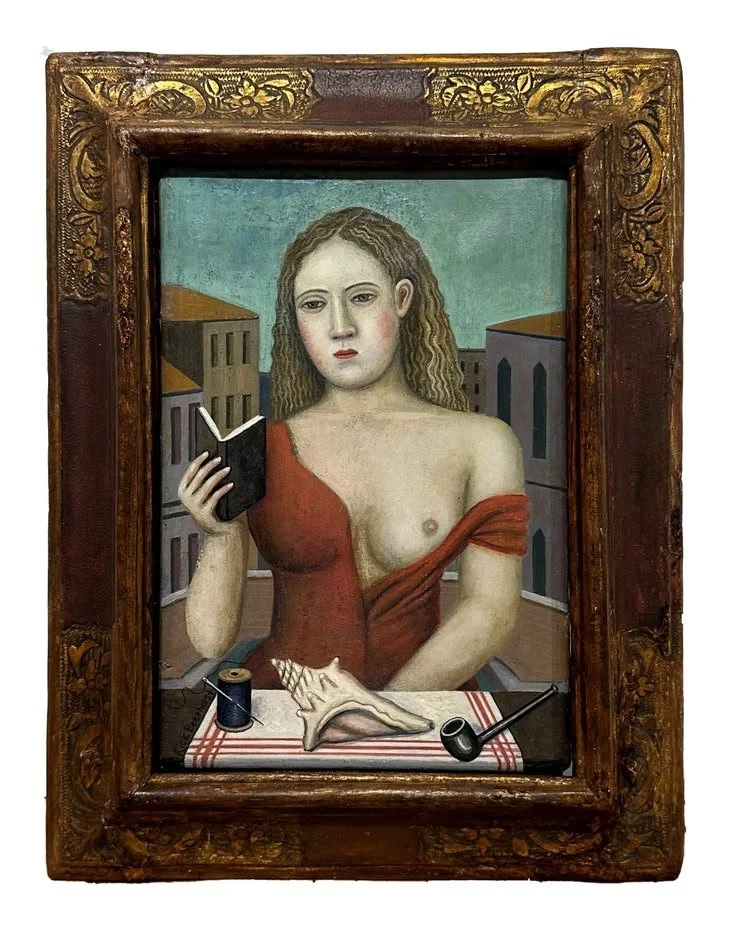
The Maid of Burano is one of those paintings.
At first glance the composition appears simple. A young woman sits at a striped table. She holds a small book. The atmosphere is quiet and self-contained.
But on the table in front of her are three objects placed almost casually:
a shell
a spool of thread
a pipe
Once you begin to look closely, these objects start to form a kind of conversation.
The Shell
The shell is the oldest object in the painting.
A shell once held a living creature. Now it remains as a beautiful structure shaped by life but no longer containing it.
For centuries shells have carried associations with pilgrimage, the sea, and with Venus emerging from the water. They are also symbols of something that once lived and has left its imprint behind.
That meaning resonates strongly with the history of this particular painting.
The linen on which the image is painted had already lived another life before I began working on it. An earlier painting once occupied that surface. I sanded it down and began again.
In that sense the painting itself is a kind of shell.
It holds the echo of a previous life beneath the surface.
The Thread
The spool of thread introduces another idea.
Thread connects things. It binds pieces of fabric together so they can hold.
In mythology thread is often associated with the Fates, the women who spin and measure the thread of life.
But thread also belongs to the everyday world of making and repairing. It is the tool used to mend something that has been torn or worn.
Placed beside the shell, the thread suggests continuation.
A life that ended becomes the beginning of another line.
The earlier painting gives way to the present one, but the surface carries that earlier history forward.
The Pipe
The pipe is the most human object on the table.
Historically pipes appear in paintings as symbols of contemplation, of the artist or thinker sitting quietly and reflecting on the passage of time.
Compared to the shell and the thread, which belong to nature and myth, the pipe belongs to ordinary human life.
It represents the maker.
The person who sits at the table and works.
A Small Triangle of Meaning
When these three objects are seen together they form a quiet symbolic triangle.
The shell speaks of what came before.
The thread speaks of continuation.
The pipe speaks of the human hand that carries the work forward.
Without planning it, the painting began to describe the very process through which it was made.
A previous image disappears but leaves its trace. The thread of making continues. The artist participates in that unfolding story.
The Woman and the Book
There is one more element that completes the composition.
The woman herself holds a book.
Books are repositories of memory. They gather stories and preserve them so that they can be read again later.
Placed within this small still life of objects, the book suggests that the entire painting is itself a kind of record.
Not only of the subject, but of the life that surrounded the making of the work.
A Painting as a Vessel of Time
One of the things that continues to fascinate me about painting is that every work quietly records the life around it while it is being made.
Temporary studios.
Journeys.
Rooms borrowed for a season.
People who appear for a while and then disappear again.
By the time a painting reaches the wall where it will finally live, it has already gathered years of biography inside it.
The Maid of Burano carries traces of Bavaria, Burano, Paris, Chicago, and Tuscany. The linen itself carries the memory of an even earlier painting that once occupied that same surface.
Objects like the shell, the thread, and the pipe become small signals of that layered time.
They remind us that paintings are not simply images.
They are vessels.
And occasionally, when we look closely enough, they reveal the quiet story of their own becoming.
Where the Painting Lives Now
The Maid of Burano eventually found its home with a collector in Michigan.
Like all paintings, it has now entered a new chapter of its life.
It sits in a room I may never see again. It witnesses mornings, conversations, quiet evenings, seasons passing outside the windows. Over time it will gather another layer of biography that belongs entirely to the people who live with it.
That is one of the quiet mysteries of painting.
A work begins in the solitude of a studio, travels through many hands and places, and eventually becomes part of someone else’s daily life.
If you are curious to explore more of these works and the stories behind them, you can wander through the archive here:
Each painting carries its own small journey.
Sometimes those journeys intersect with our own lives in unexpected ways.