Live Your Best Impossible Life
I have learned something the long way around.
A good life does not ask permission.
For the last several years, my life has looked, from the outside, irregular at best and reckless at worst. I have lived in places I was told I had no right to occupy. I have been removed, displaced, and locked out more times than I can count. Sometimes it came with polite smiles and paperwork. Once it came in the middle of the night, when I was pulled from my bed and beaten until I was left in the street, half naked and bleeding. I have slept in beauty and in precarity, sometimes within the same month.
And yet, when I tell the story honestly, something else emerges.
I had a lot of very good days.
I once lived alone in an abandoned stone house on a mountain in Tuscany. It had no running water, no electricity, and no assurances. What it did have was silence, forest light, and the slow discipline of making a place habitable with my own hands. I scavenged wood from a defunct cattle barn, cut chestnut trees from the forest, hauled a wood stove up the mountain with borrowed tools and the help of a friend’s tractor. At night, wild boar rutted through the leaves and roe deer cried out in the dark like something ancient remembering itself.
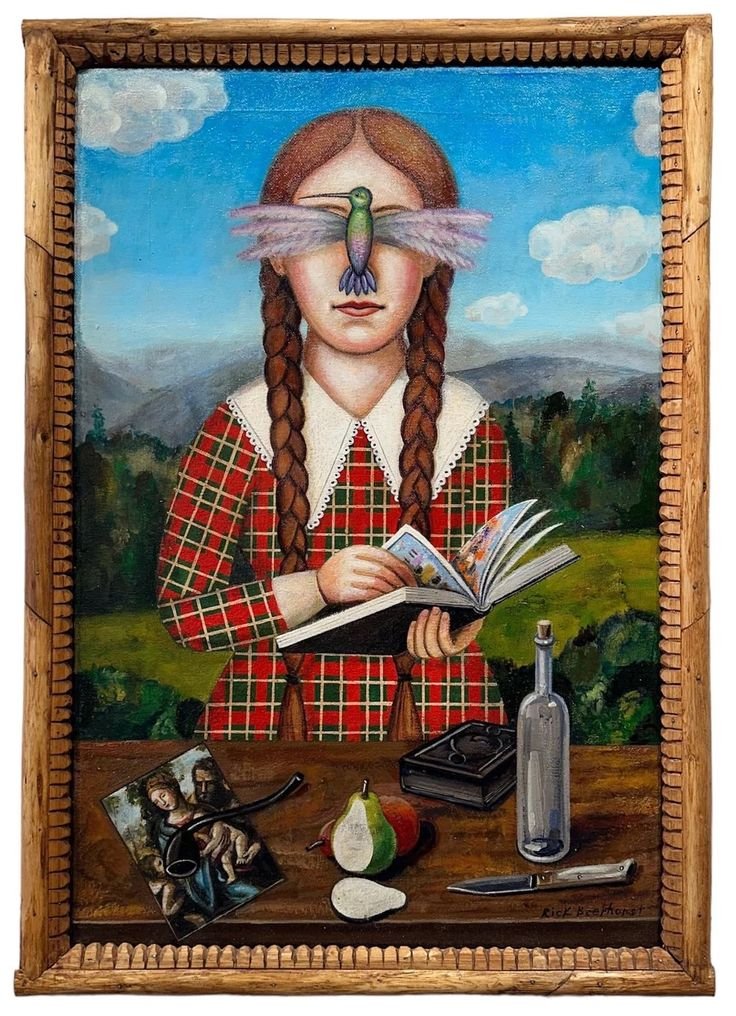
Hummingbird Girl (with Her Book), oil on canvas, 23.5 x 15.75 inches, SOLD
After five months, the predictable happened. The police came. The owner was angry. I was given two days to leave, then told I wouldn’t even have that. The lock would be changed.
That night I packed what mattered. I burned what I couldn’t carry and didn’t want discovered. I took my paintings off their stretchers and rolled them. At dawn, I rode down the mountain with my life in a duffle bag and my guitar on my back. I sold my bicycle for a hundred euros and caught the early bus to Florence, where I had arranged to meet a woman for one evening and nothing beyond it.
Three hours later, standing in the train station, my phone lit up.
It was a message from the owner. The angry one. The lawyer.
“I went to the little house today,” he wrote. “I saw what you did. I could hardly believe my eyes. You are a kind and beautiful man. What you did is unbelievable. Please come back. You can stay as long as you wish. I am so sorry. I just didn’t know.”
I returned after that single night in Florence. I bought my bike back. I rode up the mountain again. The next day he came with his sister and food from his mother’s kitchen, still warm. In Italy, that is not hospitality. That is adoption.
I exaggerate nothing. It happened exactly like that.
Years later, a painting I made in that stone house sold through a gallery in Chicago for $5,600. The frame was handmade from a wild chestnut tree I cut from that same forest. When I shipped the piece from Italy, I labeled it a “card table” and valued it at seventy-five euros because I didn’t yet have the right tax number to move art across borders.
It traveled under a temporary name.
Later, it stood in the light.
I am not telling you this to romanticize hardship or excuse systems that fail people. Violence is violence. Displacement wounds the body. Injustice is real. I’ve known all of that too well.
But there is another truth running beneath the dominant cultural story, and it’s one we’ve been trained not to see.
The lives that matter most rarely unfold inside clean lanes.
The apostle Paul didn’t wait for stable housing before writing letters that would shape civilizations. Esther didn’t save her people from the safety of the sidelines. These stories are not about virtue rewarded with comfort. They are about people placed improbably, operating without guarantees, whose depth was forged before their legitimacy was recognized.
Hollywood tells us a different myth. So does advertising. So does the trillion-dollar pornography industry and the insistence that a life only counts if it arrives wrapped in youth, money, and a retirement plan polished like a coffin.
Those are pacifiers.
The older stories say something riskier and far more useful:
Meaning precedes permission.
Depth precedes security.
Value often exists long before it is allowed to declare itself.
Living an “impossible” life doesn’t mean living irresponsibly. It means refusing to postpone aliveness until conditions look respectable. It means creating beauty inside constraint, telling the truth even when it has to travel under an alias, and trusting that what is real will eventually reveal itself.
Not on your timeline.
Not without cost.
But unmistakably.
If there is anything I have learned, it is this:
You are not here to wait until the world agrees with you before you begin.
You are here to live in such a way that, one day, the world has to revise its story.
That revision may come late.
It may come quietly.
But it comes.
Live your best impossible life.
Not because it’s easy.
But because it’s the only one that tells the truth.