Layered Time and Paintings as Thresholds
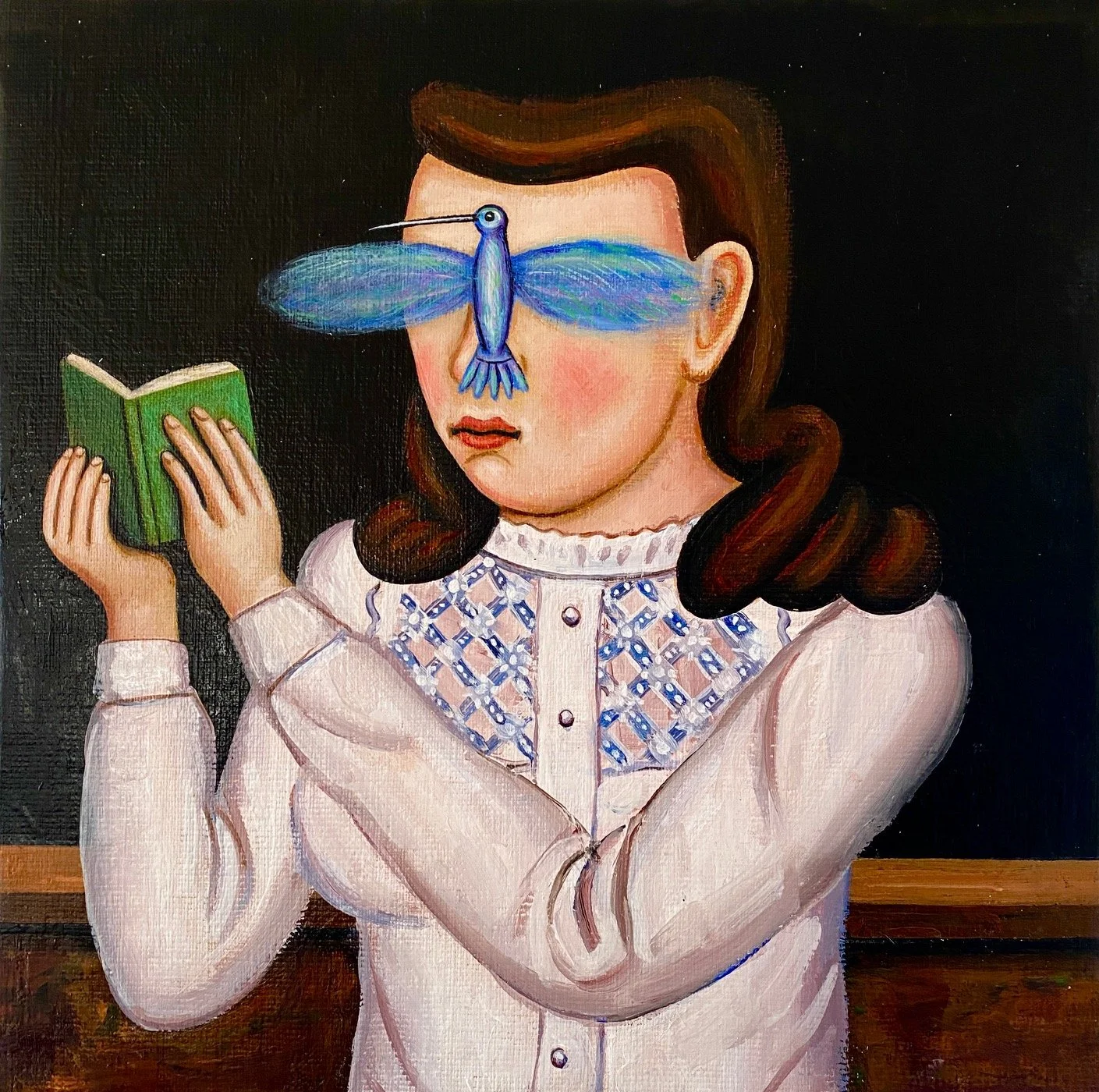
My Favorite Book, oil on linen, 30×30cm
This morning began the way many of my mornings do now.
Before the city fully woke.
Before language arrived with its errands and obligations.
A long meditation.
A slow walk through the body.
Attention oscillating between focus and openness.
Converging, then widening.
Center by center.
Until awareness no longer felt housed in me, but threaded through me.
Afterward, I noticed the familiar sensation.
As if something had been tuned.
Not revved up.
Quietly calibrated.
Like an engine idling so smoothly you almost forget what it’s capable of.
I looked up and saw the painting on my worktable.
A piece I’ve been developing slowly this past week.
Lovingly.
Without forcing it to resolve too soon.
And the question arrived without drama:
Do I actually understand what I’m making?
Not in terms of style or subject.
But in terms of function.
Because something has been happening to me lately when I stand in front of certain paintings. Not just my own. Others too. Museum rooms. Small galleries. Private homes.
I stay longer than expected.
Time doesn’t stop.
But it loosens.
And during that lingering, something subtle begins to occur.
A kind of interior re-alignment.
Old impressions float up without stories attached.
Memories without names.
Familiarity without origin.
Sometimes it feels like a forgotten language brushing the surface.
Not something I once learned, but something I once knew.
Words, I’ve come to realize, don’t belong to that moment.
Words belong to linear time.
They move forward.
Sentence by sentence.
Cause, effect, explanation.
But what happens in those moments of sustained looking belongs to something else entirely.
It belongs to layered time.
Layered time isn’t sequential.
It’s simultaneous.
Multiple registers of experience are active at once.
Body sensation.
Emotional tone.
Spatial awareness.
Memory without narrative.
A sense of meaning without conclusion.
Nothing is “next.”
Everything is already present, just at different depths.
At this point, the essay could easily explain itself.
But explanation would pull us back into linear time.
What follows doesn’t aim to clarify so much as to stay.
If you’d like to linger a little longer inside this question, the rest of the piece continues below for paid subscribers.
And the moment I try to explain what’s happening while it’s happening, the experience thins. Language pulls me back to the surface. Not because it’s wrong, but because it’s designed for reporting, not inhabiting.
This is where another realization has been quietly forming.
What if layered time corresponds to how our true mind actually works?
Not as something confined to the brain alone, but as a distributed intelligence.
A through-line of awareness running up the body and, at times, beyond it.
Thinking not only through thought, but through posture, sensation, resonance, and presence.
When attention settles into layered time, cognition stops feeling like analysis and starts feeling like listening.
The body participates.
The space around the body participates.
Awareness becomes less point-like and more atmospheric.
Deeply embodied.
And strangely unbounded.
This isn’t dissociation.
It’s integration.
And it makes me wonder whether certain paintings, when made and encountered under the right conditions, can function less like images and more like thresholds.
Not portals that promise escape.
But quiet relocations of attention.
Paintings that don’t demand interpretation.
Paintings that reward staying.
Perhaps this is why I’m increasingly drawn to restraint.
To ambiguity.
To images that don’t rush the viewer toward meaning.
Perhaps my work isn’t asking to be understood so much as inhabited.
When someone tells me, “I stayed longer than I expected,” I now hear it differently.
Not as a compliment.
But as a temporal confession.
Something in them found permission to surface without being interrogated.
And maybe that’s enough.
Maybe meaning doesn’t need to be delivered.
Maybe it only needs a place to arrive.
Paris, on a quiet Sunday, feels like a good place to let that question remain open.
If you’ve ever stayed longer than expected, I’d love to hear where that lingering took you