The Sandbar Before Deep Water
The morning before we went sailing, I found a Polaroid.
Ray had taken it the previous spring with what I believe was a Polaroid Land camera. One of the expensive ones. The kind that spit the image out in your hand like a small miracle. Peel, wait, reveal.
I remember that camera as another one of my mother’s episodic overindulgences. She was born in 1930, my mother, Althea June Bassett-Beerhorst. When the manic weather rolled in, beautiful and costly things appeared in our modest house. A train set too expensive for our income. A camera that developed photos instantly. Purchases that thrilled her and tightened something inside my father.
My father carried his anxiety quietly. Immigrant restraint. Post-war discipline. Bills did not feel like miracles to him.
But that camera captured her under the flowering crab apple tree in the front yard of 4591 Burgis Street.
That tree was a seasonal ritual. Every year someone posed beneath it when it bloomed. Proof of return. Proof that winter had not won.
She was sitting in one of those tubular aluminum lawn chairs with plaid nylon webbing. The kind you fold flat and toss into the trunk for the beach. Weighed next to nothing. Portable comfort.
Sun dappled through shade on her shoulders. A sun dress. Calm. Alive.
She had died four months earlier in her sleep. Pulmonary edema. Forty years old. I was nine when she died. Ten by that June. I think she just wanted it to be over.
I remember holding that Polaroid and trying to solve a riddle my ten-year-old mind could not compute.
How does someone exist last spring
and not exist this one?
The blossoms were real.
The chair was real.
The instant photo in my hand was real.
But she was gone.
I studied that image like it might reveal instructions. If I stared long enough maybe disappearance would explain itself.
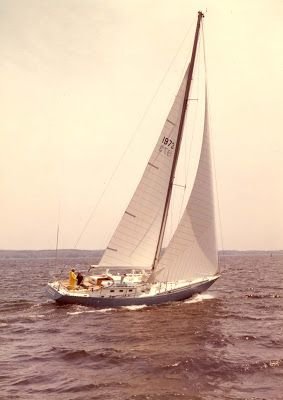
The next day my father, Rolf Hendrik Beerhorst, and his brother Andrew took me sailing.
The boat was docked among dozens of others in a marina inlet, hulls pressed side by side, masts clinking lightly in the breeze. We had to taxi out first, engine running low and steady, weaving between slips and wooden pilings before we ever raised sail.
Lake Macatawa. Protected water before exposure.
Only after clearing the inlet did we hoist canvas.
And before we ever reached open Lake Michigan, before the shoreline vanished from view, we ran aground on a sandbar.
The keel scraped bottom.
The boat stalled.
Four months into a world without my mother, that grinding felt familiar.
Andrew dropped below deck and fired up the big Cadillac engine mounted inside the hull. He had learned to sail with my grandfather in the rough waters of the North Sea. Hard wind was normal wind to him.
The engine rumbled. The hull lifted. Forward motion returned.
Two brothers. Immigrants. Men who had already crossed oceans.
I trusted them completely.
And then the shoreline disappeared.
That detail matters.
Four months after my mother’s sudden death, I was physically moving into a space where land was no longer visible. I did not freeze. I did not ask to turn back. I leaned forward.
I would never set foot on that boat again.
Years later Andrew sold it. Time does what time does to bodies that stop moving and eat too many rich restaurant meals. The old racing sloop that once leaned hard into wind became someone else’s story.
But that one voyage stayed with me.
The Polaroid in my hands.
The expensive camera.
The crab apple blossoms.
The sandbar scrape.
The engine catching.
The land vanishing.
I did not solve the riddle of my mother’s existence and non-existence.
I sailed into it.
Temporary grounding does not mean the voyage is over.
Deep keel keeps you upright in strong wind.
There is always an auxiliary engine.
I knew I was in good hands then.
I know I still am.