The Place Where Two Worlds Meet
In 1974 I was a curious adolescent of 14 living in a brand new Michigan suburb. As soon as I got home from school, after watching one more rerun of Gilligan’s Island, I was out the door with my rucksack filled with sketching supplies. I loved to ramble the wilderness that began at the end of our paved street. It was there that a gravel began that lead into the fields and woods surrounding Old Farm Estates, the subdivision that my newly re-married parents built our family home just two years earlier. It would be those fields and patches of woods that would thus become the perfect territory for my self guided nature studies.
The Get big or get out! mantra that was killing off small farms left and right through out the midwest during the 60s and 70s left hundreds of thousands of former corn and wheat fields fallow, gradually returning to pre-cultivation wilderness. Of course most of all this land would be soon gobbled up by all the new suburban developments and shopping malls that spread like cancer through out the entire U. S. at this time
It was one such afternoon that I would discover a tiny pond in a small clearing in a patch of woods. Like a small meteor that had landed a million years ago, it had a giant rock right in the center that formed a sort of island. There would often be three or four big lazy looking frogs sitting on that rock, sunning themselves when I arrived.
I would return to this spot again and again that year. It felt special, mysterious and best of all, it felt like mine.
In the first few weeks of my East Kentwood High School biology class with Mr West, we were told to come to class with a sample of pond water to observe under our microscopes. Of course it was to my secret pond in the woods that I would dip my empty pickle jar for a water sample. I will never forget the first time looking through the lens of that microscope at a single drop of pond water. It was nothing short of a revelation - a whole world with in a world and I was seeing it for the very first time.
The edge of a pond is an extraordinary place, rich in biodiversity. It’s what scientists call an ecotone. It’s the liminal space where two distinctly different worlds meet- land and water. This is where the fish come to lay their eggs in the spring, where frogs like to sit stone still, half submerged waiting for unsuspecting flies to come into range of their long sticky tongues. This is where I sat hunched over a drawing pad doing my 14 year old best to jot down what I was seeing and and feeling on the edge of my favorite place in the world other than our Panasonic color television set.
In those years my heroes where not pro athletes like Bart Star and Joe Namath who graced the football cards my buddies seem to treasure. I was reading the biography of Madam Curie and making pencil sketches of Albert Einstein with his crazy mess of white hair and extra bushy eyebrows. The mix of art and science was instinctual for me because I hadn’t yet learn to separate the two. I remember when I finally got to college wondering why the science department and art department where hosted in different buildings and seemed to occupy completely different worlds.
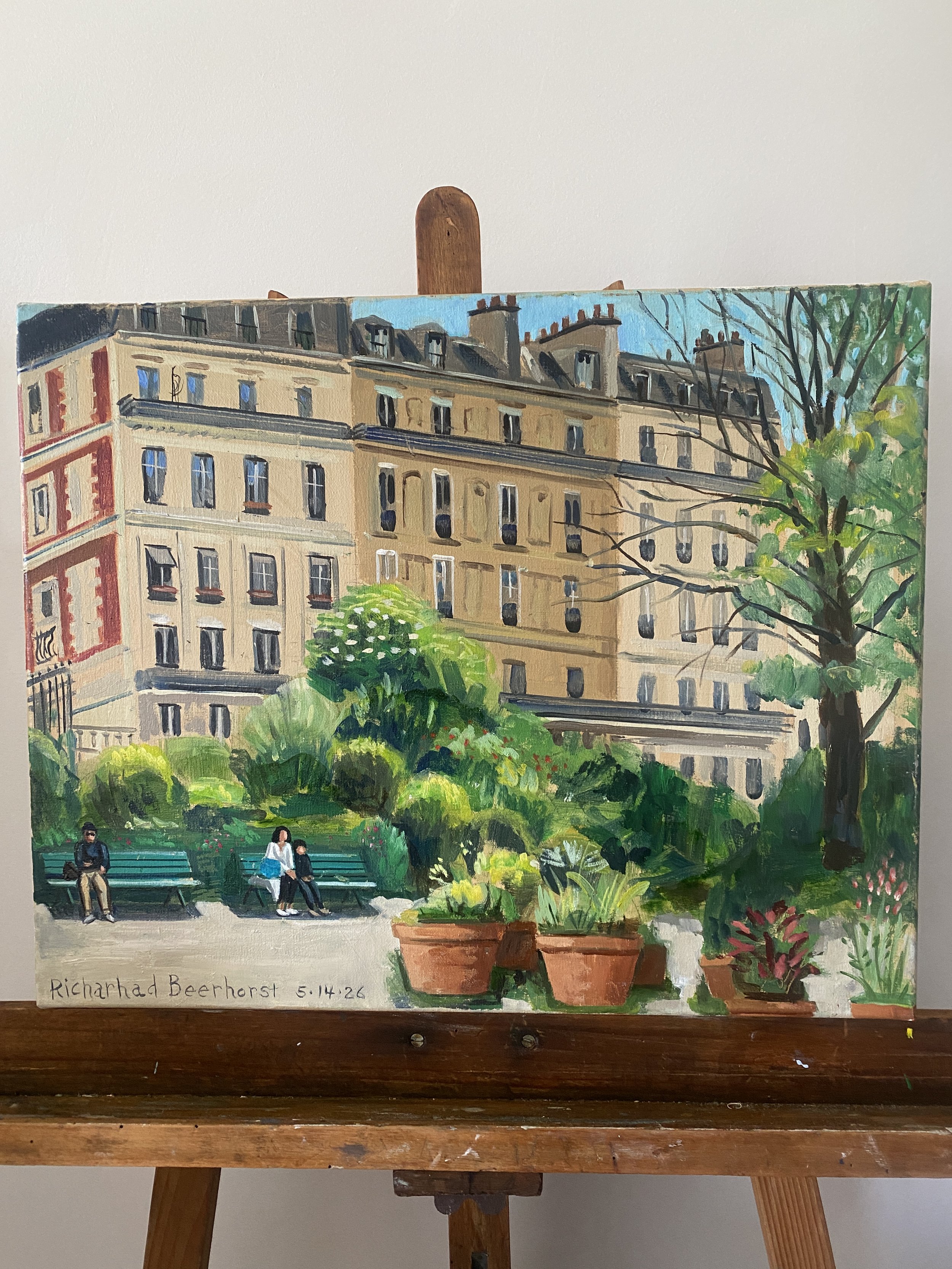
So all these years later I find myself living in Paris France making my way to the Square Park Gardette nearly every day with a rucksack filled with drawing materials, pulling my portable easel on a grocery caddy with yet one more brand new canvas ready to capture a scene. When I was 14 it was a pond hidden in the woods. Today it’s this park, another sort of ecotone, a place where life flourishes between the man made structure of urbanity and the wilderness of the natural world. A place where I can slip out of my shoes and socks and let my bare feet finally touch the earth again.
To make art in a place like this, in public, has the very same feeling of wonder I felt as a 14 year old boy leaving the end of a paved street for the wilderness edges of a brand new suburb.